Looking Back
By Mark Albertson
“The Army Air Corps is Back,”[1]
* * * * *
Few taxpayers are aware of the needless expense caused by the duplication of Air Force functions through the formation of another air force by the United States Army. In fact, this Army air force comprises a fourth air force. Complementing those now existing of the Navy, the Marines, and the United States Air Force itself. The wastefulness of this action is shown in the plans of each commander of a field army to use 939 Army aircraft. These are in addition to the Air Force aircraft available to him from normal theater support. The latter alone could adequately supply all his needs. The assignment to individual commanders of airplanes is a throwback to the penny packet method of distributing aircraft learned to be so fallacious in the early North African campaign of World War II. This requirement of almost a thousand Army airplanes in each field army, (of which three are now eight) to perform functions which the Air Force can do most economically, without increased cost to the taxpayer in additional planes, merits careful consideration. It is a subject which should receive close scrutiny by the public, the Bureau of the Budget, and Congress.
The natural desire of an Army commander to control his own aviation, while commendable from the individual commander’s limited viewpoint, must be evaluated in the light of what will give the greatest good to the nation. It has been reiterated many times in recent months that the most pressing problem facing the nation is the maintenance of adequate defense forces for security within our national economy. This cannot be done if the Army continues to obtain and to use airplanes based on concepts of operation learned in World War II and Korea. In truth, some Army concepts of operation even harken back to the Civil War when the mule-drawn vehicle was the best transportation known. The Army is unfortunately downgrading the use of airpower in these obsolete fashions, for it treats the plane as a faster kind of truck or horse to be used over the same route and distances established by trucking methods. Similarly concept of tactical operations still confine its activities to a combat zone geographically defined based on former ground limitations. However, one lesson now being relearned through hard experience by other users of airpower is now being relearned by the Army. That is, the requirement for centralized control of the airpower that it does possess to obtain maximum usefulness. Attempts are being made to do this in the Army Transportation Corps over the objections of other branches and corps of the Army desirous of capturing individual control. This fourth air force, in addition to airplanes, is wastefully duplicating pilot and mechanic training schools as well as supply and maintenance facilities. In fact, with plans for completed world-wide air mobility of the Army, the Army is building up an air force with which it hopes to become entirely independent of any support of the present Air Force.
One example of the wasteful use of aircraft planned is the assignment, within the 939 planes of the field army, of sixty helicopters to be used for the sole purpose of medical supply and evacuation, in addition to this, 467 helicopters may be secondarily used for this purpose. Actually an Air Force troop carrier assault squadron of sixteen helicopters could evacuate from 1,000 to 5,000 casualties per day, which should be adequate for the most pessimistic of commanders. For if this commander intended to use as many as 527 helicopters for casualties, his war would soon be over in favor of the enemy.
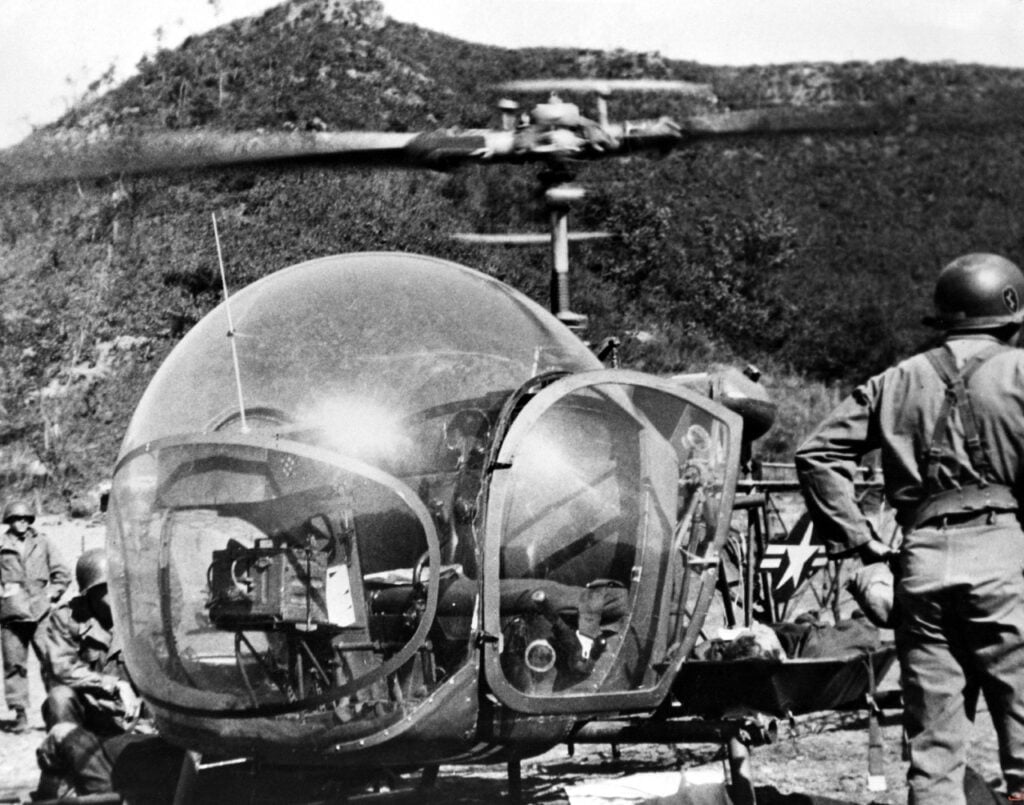
An OH-13, from the 25th Infantry Division, evacuating casualties during the Korean War.
However, this wasteful duplication is not the most serious problem presented by the fourth air force. The real problem which will exist with the large number of Army planes programmed for a combat area, will be that of tactical control. A single centralized tactical control system must be set up to identify all planes, locate targets for friendly aircraft, and permit flexibility of assignment of aircraft in a theater of operations. This centralized combat system is now possessed by the Air Force. A duplicating system set up by the Army Air Corps or none at all, to control Army planes would soon make the air over the battle area a snarled-up mess and lead to disaster. Proper air cover must be given throughout a controlled system, for any reconnaissance, supply troop carrier or evacuation missions. One single agency must control all types of air operations in combat, whether fought on the patterns of pre-atomic days or the new concept of flexible mobility and dispersion.
It is to be noted that the Army appears justified in its demands for more air transportation and air support, when considered with the requirements presented unilaterally by the Army. However, when an analysis is made of the actual airlift needed to fight a new type of war with a hard-hitting compact army devoid of many weighty, obsolete, logistical organizations, it is seen that the requirements are preposterous. They are based on the airlift needed to move World War II type armies from mudhole to mudhole.
In the past, budgetary limitations have necessitated the expenditure of most Air Force funds, and justifiably so: To build up the Strategic Air Command as a ready striking force to prevent war. Now, with the need to develop armies that are truly air mobile, it is logical that the Air Force should be the proper custodian of the job in order to do it best and most economically. We should not be influenced by the precedent set in the recent past, of the Army attempting to enter the air business due to default of the Air Force because of its limited budgets. Millions can be saved by taking from the Army all aircraft other than a few small planes needed by commanders for liaison, and even this latter allocation is probably not necessary. It is not unlikely that billions could be saved if the Army coordinated its tactics with proper use of airpower and cut out obsolete methods of operation based on surface-bound views. The claim that scientific advances have now made one airplane capable of doing the work that thousands did in World War II also can be applied to the functions of the infantry. As an example, one ground soldier controlling a number of rocket field pieces can do the work of an entire field artillery regiment.
The resolution of this problem will require a little knocking of heads together by the Commander-in-Chief and the Secretary of Defense. It will require telling the Army to stick to its own business. It will require that the Army cooperate and not compete with the Air Force in developing techniques of using air and ground power to the best advantage of the Nation. It will require that this fourth air force concept be abandoned by the Army.
There is a best way to do a job. The nation’s economy demands that it have that best method through proper unification of the services and the prevention of duplication or quadruplication. National survival and not service survival is at stake.
Colonel Moneysaver
* * * * *
Rebuttal
Colonel Moneysaver’s concluding line is a summation more in tune with that of a political culture as opposed to that of a military dogma: “National survival and not service survival is at stake.” For starters, neither the Air Force nor the Army was in danger of closing its doors in 1955. Rather, it is the control of tactical aviation that is the bone of contention. Indeed, during the late 1940s, even naval air and Marine Corps air will feel that Air Force confidence in controlling airpower. But, of course, the butt of the argument is Army Aviation, as it had graduated, by 1955, from what it once actually was, the Air Observation Post. The Korean War was proof positive where the Army was taking the development of tactical air and, doing so with the helicopter. And, as the writer’s name indicates, the issue of money, taxpayer dollars, is another focus. Control the money, control the agenda. After all, this is a Capitalist country. So follow the money.
The argument posed by Colonel Moneysaver was decades in the making. Go back to the first chapter of the Great War,[2] on the Western Front, the stalemate of the trenches, where the armies of the Triple Alliance and Triple Entente were mired in that gridlock of shot and shell and mud and No Man’s Land. Far thinkers such as Sir Hugh “Boom” Trenchard, Giulio Douhet and our own Billy Mitchell thought the airplane could break the stalemate. That with the proper bombers an air fleet could take war to the enemy’s capability to wage industrialized war. And do so by targeting such necessities as the factories, port and dock facilities, railroad tracks and rolling stock, communications infrastructure, fuel supplies, ammo dumps, and other targets of consequence to an industrialized war effort. Douhet even added the bombing of the enemy population, since the people might put pressure on their government to conclude the conflict quickly.
History will bear out that Douhet’s notion of bombing the civilians will not always prove an advantage. 1940, the German “blitz” against the British; 1942-1945, Allied bombing of Germany; the later U.S. bombing of North Vietnam, if anything raised the people’s ire to resist.
But to strategic airmen in the United States, the bomber was that medium for an independent service, that ticket for that divorce from the Army. For the bomber represented offensive airpower, in lieu of the fighter which represented defensive air power. And during the 1920s and 1930s this ideal became more and more prevalent.
The Ground Forces of the Army were very much concerned that the tactical requirements of the rifle totter would not be addressed; a concern that was justified. For many of the observation aircraft being designed were large, speedier and hardly conducive for proper ground forces observation and reconnaissance. Yet, too, military aviation was becoming too sophisticated to be controlled by ground officers; or, so it seemed. . .
During the second chapter of the Great War, the United States Army Air Forces will never field an aircraft that was devoted solely to ground support and tank busting. Nothing that was American-built of was of a similar effort to the superlative Illyushin IL-II Shturmovik. Indeed, Eddie Rickenbacker, “was shown a demonstration of the Shturmovik’s capabilities and recorded the view that it was the best aircraft of its type in the world; that his country had never produced anything in the same class of machine. . . “[3] The Shturmovik will go on to become the most produced combat aircraft in history at 36,183 copies.
The American equivalent was the P-47 Thunderbolt. The “Jug” was one of the best fighter planes produced by the United States during the second chapter of the Great War. Yet as a ground support tank-busting aircraft, it was a distant second to the Shturmovik. Quite frankly, the United States Army Air Forces did not design an aircraft of the Shturmovik’s quality because it was focused on strategic aviation, which was the strategic airmen’s concern. Arguably then, the best “ground support” aircraft produced by the United States was the L-4 Piper Cub. Manned by Field Artillery personnel, pilots and observers, these flivver planes could focus battalions of artillery onto a single target so as to obliterate same.[4] These aircraft, too, were organic to the units assigned to. And were on the beck and call of the units assigned to. Meaning, they were controlled by the Ground Forces, not the United States Army Air Forces, something of an anathema to the U.S.A.A.F. and, which helped to plant the seeds for that continuing difference of opinion as to who will control ground forces tactical aviation after 1945.
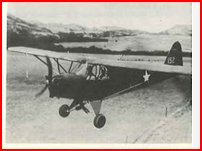
The Piper L-4 Cub was the aircraft that put the Air Observation Post on the map. But by the Korean War it was obsolete.
The L-4 Cub was that aircraft that proved the signature expression of the Air Observation Post, later to evolve into Army Aviation. But following 1945, growing obsolescence will see to the Cub’s replacement, owing to the changing nature of ground forces requirements.
Demobilization followed the cessation of military operations with the conclusion of the global conflict. Starting after September 2, 1945 and out to March 31, 1947, the U.S. Army downsized from 89 divisions to 10, with many of these understrength. The Navy shrank from 1,000 ships to some 300, a seventy percent drop. The U.S. Army Air Forces declined from a high of 213 combat groups to 63; and of these, only 11 were up to full strength.[5]
A corresponding drop in military spending fortified the “peace dividend” leading up to the Korean War. Starting with 1946 from $42 billion down to $14 billion in 1947 to $10 billion in 1949. As a percentage of G.N.P., from 20.7 percent in FY 1946 to 4.4 percent in FY 1947.[6]
* * * * *
July 26, 1947, the National Security Act. With this significant development the U.S.A.A.F will be divorced from the Army to become the United States Air Force. Marine Corps air will remain under the umbrella of the Navy. The War Department was done away with. Instead, three new departments were formed: Department of the Air Force, Department of the Army, Department of the Navy. With the latter, the Marine Corps will retain their air capability and will utilize said capability so as to fulfill those requirements assigned to them as part of the Department of the Navy.
Then the newly-minted Air Force: “In general the United States Air Force shall include aviation forces both combat and service not otherwise assigned. It shall be organized, trained, and equipped primarily for prompt and sustained offensive and defensive air operations. The Air Force shall be responsible for the preparation of the air forces necessary for the effective prosecution of war except as otherwise assigned and, in accordance with integrated joint mobilization plans, for the expansion of the peacetime components of the Air Force to meet the needs of war.”[7]
Now within the second stanza of Colonel Moneymaker’s “The Army Air Corps is Back,” he levels criticism as to the Army commander’s control of his own aviation, or aviation organic to said command, as detrimental to the Nation, based on the concepts of World War II and Korea. Adding here, too, of the duplication of pilots and training schools.
Armies glean and review the mistakes and successes of the previous war so as not to repeat the sins of same in fighting the next. This is precisely what Major General James M. Gavin was attempting when he wrote, “The future of our armed forces is in the air. All the fighting men and everything they need to fight with in the future and live on as they fight must be capable of movement by air.”[8]
General Gavin understood the limitations of parachutes and plywood gliders for the purpose of inserting troops behind enemy lines. For his concept will necessitate new aircraft, new tactics, new training methods. Thinking along the same lines was Lieutenant General Roy S. Geiger, Commander, Fleet Marine Force, Pacific Fleet. In 1946, he attended the Navy’s atomic bomb tests at Bikini Atoll, where 247 ships were moored in the Bikini lagoon. Upon his return to his office at Pearl Harbor, he wrote a letter to Marine Corps Commandant, General Alexander “Archie” Vandergrift. To the effect that amphibious landings as seen at Sicily, Normandy and Okinawa were becoming a thing of the past. Warning of the devastation of a single atomic bomb dropped on a beach crowded with troops, he suggested the use of light aircraft to disperse assault forces in and around the beaches and then at the proper time the use of such aerial assets to effect the consolidation of such forces to commence operations.
General Vandergrift supported Geiger’s thinking out-of-the box which will result in the Vertical Assault Concept. To which concern as to the effects of the atomic bomb will help lead to the post-1945 development of the helicopter. With the Marine Corps, the Vertical Assault Concept will see to the conversion of World War II escort carriers into amphibious assault ships able to carry helicopters and marines. It would seem that here, both Gavin and Geiger understand that the helicopter unlike parachutes are much more accurate in landing airborne assault troops in assigned areas of operations and are consistently more reusable than plywood gliders. Unlike the French in 1940 who fought the Wehrmacht as it did the Kaiser’s army in 1914, both Gavin and Geiger were not seeking to fight the next war as it was done in 1939-1945.
Stanza three, Colonel Moneymaker’s criticism of Army aircraft being used for “medical supply and evacuation.” Author’s argument was that “an air force troop carrier assault squadron of sixteen helicopters could evacuate from 1,000 to 5,000 casualties per day . . . for the most pessimistic of commanders. For if this commander intended to use 527 helicopters for casualties, his war would soon be over in favor of the enemy.”
Let us understand the reality here. Colonel Moneymaker is elaborating on a long-sought agenda by airmen for airmen for independence from the Army. This is in the face of now the Army’s expression of pseudo-independence from the Air Force. And same is based on why? Recent history.
March 1946, Tactical Air Command was formed, based on a promise Army Air Forces Commander, General Carl A. Spaatz, made to Army Chief of Staff, General Dwight D. Eisenhower. Yet nine years later, 1955, the Air Force had no intention of fielding an aircraft solely for the purpose of close air support; rather, aircraft to establish air superiority and, once established, support of the ground forces will rely on jets of high speed, to which, too, are multi-role aircraft in keeping with Air Force independence. Indeed, T.A.C. aircraft were being modeled for low-level nuclear ordnance. Hardly the C.A.S. requirements of the ground forces. In fact, during the early stages of the Korean War, the Army Chief of Staff called for the subordination of Air Force aircraft conducting air support to army corps and division commanders, including Air Force fighter-bomber squadrons being attached to each Army division.
“In Korea itself, in 1950, the Army got to experience the apparent benefits of Marine tactical air doctrine at first hand when Marine aircraft provided dedicated support to Army units during the defense of the Pusan perimeter and Inchon landings, and Army officers liked what they saw. Drawing on this experience, General Edward M. Almond, commanding the Army’s X Corps, recommended in December 1950 and again in July of the following year, that a group of fighter-bombers be allotted to the operational control of each Army division.”[9]
Yet following Korea, President Eisenhower did not want America in such a conflict, believing that the constant repetition of war would turn the United States into a garrison state. So between 1953 and 1957, the Army was cut from 20 divisions to 14. Ships were mothballed from the Navy and there were reductions in personnel. But the Air Force increased by 30,000 men and more air wings as its budget increased. For this was the era of the New Look Defense with a cornerstone of “Massive Retaliation” with the strategic bomber delivering atomic ordnance. The threat of bombing an opponent back into the “Stone Age,” was deterrence.
Yet the Army will plan and train to fight on a nuclear battlefield. It will reorganize the division structure to conform to a developing reality in the late fifties, the Pentomic Division. And the Army will bet the ranch on the helicopter, an aircraft that will be under constant development for the ground forces. And this will include Colonel Jay D. Vanderpool, who was not an aviator, experimenting with arming the helicopter, paving the way for not only the troop carrying helicopter, but future rotary wing aircraft able to provide close support for the soldier on the ground and flown by Army aviators.
Colonel Moneymaker’s article was a continuation of Lieutenant General Henry “Hap” Arnold’s earlier warning of the Army developing a rival air force. Yet there was the prophetic observation later by Pete Quesada who stated, that if the Air Force did not service the Army’s tactical requirements, that a rival air force will arise. He was, of course, proven correct.
Stanza Four: Note here, Colonel Moneysaver states that the Army “appears justified in its demands for more air transportation and air support, when considered with the requirements presented unilaterally by the Army. However, when an analysis is made of the actual airlift needed to fight a new type of war with a hard-hitting compact army devoid of many weighty, obsolete, logistical organizations, it is seen that the requirements are preposterous. They are based on the airlift needed to move World War II type armies from mudhole to mudhole.”
Rebuttal: What is preposterous here is the concerted lack of regard for history. To start with, strategic bombing, as it would come to evolve, would not have been possible without the horrific and grievously costly gridlock of the trenches in eastern France north through Belgium on the Western Front, 1914-1918. Far ranging thinkers such as Trenchard, Douhet and Mitchell saw strategic aviation as that option of taking war to the enemy’s industrial capability of waging war; to which, strategic aviation will be another facet of Levee en Masse, with the growing sophistication of waging modern industrialized, corporatized, commercialized war, Total War.
But then, within this whirlpool of Total War, one cannot just give the tactical requirements the short shrift; which lends to the question, just where does Army Aviation fit in?
Well let us begin with the demonstrated ability of the Air OPs to perform a variety of tasks other than that of the aerial direction of artillery fire, which not only enhanced its value but broadened its appeal. This became evident when other branches of the Ground Forces utilized Field Artillery Cubs for tasks and missions other than that originally intended.
In August 1945, the War Department gave the Air Observation Post a boost by enabling other branches of the Ground Forces—Armor, Engineers, Infantry, Cavalry, Tank Destroyers—to adopt the capability.[10] The agreement, which had been reached privately by Jacob L. Devers, C.G. Army Ground Forces and General Ira C, Eaker, C.G. Army Air Forces, also called for additional light aircraft for the A.G.F.[11]
Yet following the divorce of the Army and the Air Force, the latter was still procuring aircraft for the former. And despite the Army truly beginning to focus on the helicopter, the Air Force considered tactical aircraft a distant second on the priority list to that of strategic aviation.
For instance, “in 1948, Lieutenant General James M. Gavin, in his capacity as president of the Army Airborne Panel, attempted to convince the Air Force director of requirements of the Army’s need for more and larger helicopters. Finally exasperated by LTG Gavin’s persistence, the Air Force general replied,–
“I am the director of requirements and I will determine what is needed and what is not. The helicopter is aerodynamically unsound. It is like lifting oneself by one’s bootstraps. It is no good as an air vehicle and I am not going to procure any. No matter what the Army says. I know it does not need any.”[12]
In just two years, those words will be meaningless. Actually, they were without foundation when uttered. For with the opening of the Korean War, the Air Force committed two rescue squadrons, the 2nd and the 3rd. The 2nd served the needs of the 13th and 20th Air Forces and was based out of Clark Field in the Philippines; while the latter served the Fifth Air Force and covered the area in and around Japan. Among their aircraft, the Sikorsky H-5 (S-51) helicopter.
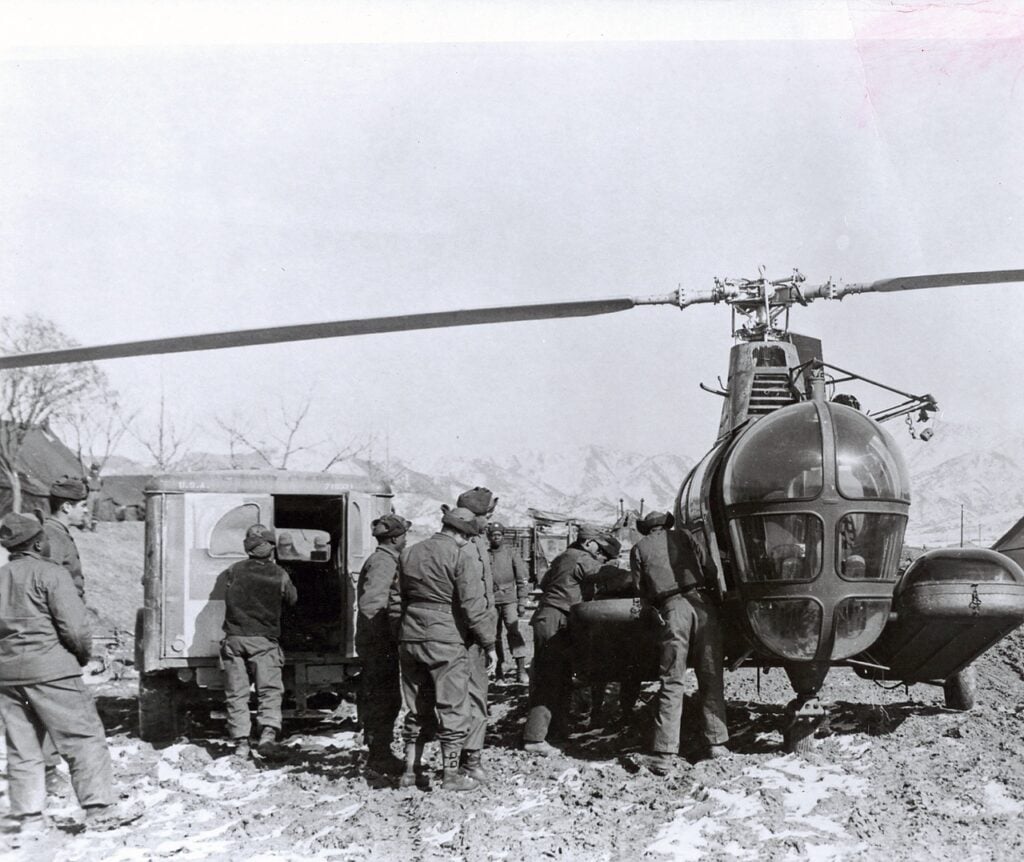
A Sikorsky S-51, HO3S-1 in service in Korea as a medivac. Note litters on the rungs.
July 7, 1950, a pair of Stinson L-5s were sent to Korea as rescue aircraft; to which among the tasks was to recover downed airmen behind enemy lines. These proved unequal to the task. For instance, the L-5, unlike the L-4 Piper Cub, was not as suitable a choice for soft ground landings such as on cow pastures and paddy areas. This, of course, was rectified with the use of helicopters. H-5s were put to work for rescue operations, flying out of Taegu[13] in the Pusan perimeter.
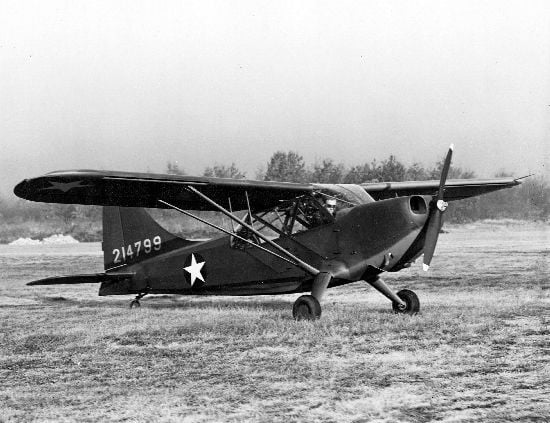
Another holdover from World War II. Used in a variety of liaison tasks in Korea, including medical evacuation. But it was quickly replaced as a medivac by the helicopter.
“By the end of August, meanwhile, the 3rd Rescue Squadron’s helicopters had flown 83 critically wounded soldiers from the battle area. All of them would almost would certainly have died had they been forced to make the journey to a field hospital by ambulance.”[14]
“By the end of 1950, the H-5s had transported 618 medical cases, compared to the 56 flown out by L-5s.”[15] Indeed, an aircraft viewed as “aerodynamically unsound,” by the Air Force director of requirements for the Army was being proved as “in error.” Though one must consider the alternative here, that the Air Force or, at least said officer, had little regard for the tactical requirements of the Army.
The Marine Corps, too was making use of the helicopter for moving men and stores and retrieving downed airmen, besides shuttling wounded to doctor’s care.
The Army did not get into action until December 1950. Bell H-13s, to be complemented in short order by Hiller H-23 Ravens, were to be used for artillery fire direction, chores of liaison and evacuation of battle casualties. By January 1951, Captain Albert Seburn was in command of the 2nd Helicopter Detachment based at Seoul. And in just a month, some 500 casualties had been evacuated.
For the Army, the eclipse was now becoming complete: The Air Observation Post was now becoming Army Aviation.
Stanzas 5 and 6: In opposition to Colonel Moneysaver, the lack of regard for history is quite evident here . . . that being, of course, the repetition of history. For history does repeat, though it is never exact, but does repeat. Or as put forth by Mark Twain, as opposed to repeating, history rhymes.
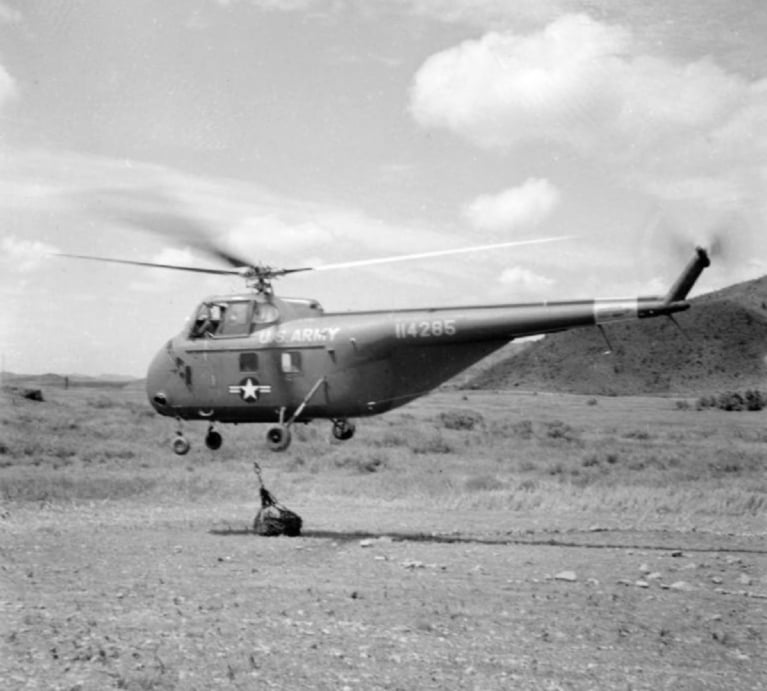
With the Sikosky H-19, the Army was now able to haul men and stores for the tactical requirements of the ground forces.
1914-1945, the evolving nature of strategic aviation, the desire of the proponents of same to seek a separate service, is based, in part, on the growing sophistication of military aviation in the era of Levee en Masse. Strategic aviation is becoming too sophisticated to be overseen by ground officers. But with the atomic age and the evolving transition of the Industrial Revolution to that of the Technology Revolution, there was and still is the evolving transition of the sophistication of ground warfare; to the extent that it should be the province of ground officers. For in the end, they will be the best qualified for understanding the rudiments of close support tactical air because they have to wage it. Marine Corps air supports the man with the rifle. So, too, Army Aviation, which provides one with a better understanding of why it is no longer the Air Observation Post. But please note, . . .
. . . thinkers of their time, such as Trenchard, Douhet, Mitchell, later William Wallace Ford, Delbert Bristol, Robert Williams, James Gavin, Roy Geiger and others like them, were revolutionaries, minorities within accepted convention but, who will alter and change the status quo. It is those who follow who cement these revolutionary ideals into the new convention and therefore, give way to a new generation of reactionary proponents who will be difficult to unseat. For as General George Seneff observed, Yesterday’s revolutionaries are tomorrow’s reactionaries.” Such is the article being critiqued, an effort into maintaining the new status quo and penned by Colonel Moneysaver, versus the perceived threat posed in 1955 by those upstarts in Army Aviation.
Endnotes
[1] See page 46, Army Aviation, February 28, 2001 issue. Reprinted with permission of Air Force Magazine, September 1955.
[2] Those familiar with past Looking Back efforts know that this writer does not conform to the accepted historical progression of World War I, 1914-1918 and World War II, 1939-1945. There is only one war, Man’s greatest industrialized, corporatized, commercialized conflict, the Great War, 1914-1922; 1931-1945. Levee en Masse, the conscription of entire economies and populations for industrialized Total War was in full bloom. The result will be the demise of European domination of the globe and a new balance of power, that of the United States and the Soviet Union. The resulting faceoff will be known as, the Cold War.
[3] See pages 12 and 13, Aircraft Profile, No. 88, The Ilyushin-2, March 1982, by Witold Liss.
[4] The venerable L-4 Piper Cub was one of the most cost effective military aircraft in American history. It was rugged, easy to maintain, able to operate from hard airfields at the rear or soft fields near the front, and, it was a bargain at some $2,000 per unit. A crew of two, pilot and observer from the Field Artillery, could zero in battalions of gun batteries onto a single target in a devastating display of firepower, as acknowledged by Germans who were on the receiving end of such firepower. A distinct improvement from World War I where hundreds or even thousands of guns shelled opposing forces minus such an advance in targeting methods.
[5] See page 2, Army Aviation: The Interwar Years, 1945-1950, A History of Army Aviation Logistics, 1936-1961, Study No. 5, by Dr. Howard K. Butler.
[6] See pages 1 and 2, Dr. Howard K. Butler.
[7] See pages 44 and 45, “The National Security Act of 1947,” The Department of Defense, 1944-1978, Office of the Secretary of Defense, Historical Office.
]8] See page 178, The Field Artillery Journal, May-June 1947, by Major General James M. Gavin, U.S.A.
[9] See page 16, Chapter 1, “The Doctrinal Background,” Inter-service Rivalry and Airpower in the Vietnam War, by Dr. Ian Horwood.
[10] See page 3, Chapter 1, “The Field Artillery in World War II,” History of the Field Artillery School, Vol. II, by the Field Artillery School.
[11] See page 15, “Academics and Training,” Part II, The Army Aviation Story, by Richard K. Tierney.
[12] See page 25, “Army Aviation Between WWII and the Korean Conflict,” by Dr. John Kitchens, Aviation Branch Command Historian, U.S. Army Center, Fort Rucker, Alabama, U.S. Army Aviation Digest, September-October 1992.
[13] Today known as Daegu.
[14] See page 108, Chapter Ten, “Battlefield Support, 1951,” Air War Over Korea, by Robert Jackson.
[15] See page 109, Robert Jackson.
Bibliography
ADA951856, History of the Field Artillery School, Vol. II, “World War II, U.S. Army Field Artillery School, Fort Sill, Oklahoma, October 31, 1946.
Butler, Dr. Howard K., “Army Aviation: The Interwar Years, 1945-1950,” History Study No. 5, A History of Army Aviation Logistics, 1935-1961, Historical Division, U.S. Army Aviation Systems Command, St. Louis, Missouri, 1988.
Fort Rucker and Army Aviation History, “20th Anniversary of Army Aviation: The Army Aviation Story,” Part II: “Academics and Training, 1942 to the 1950s,” by Richard K. Tierney, United States Army Aviation Digest, U. S. Army Training Center, Fort Rucker, Alabama, July 1962.
Gavin, Major General, James M. U.S.A., “Airborne Armies of the Future,” The Field Artillery Journal, Vol. 37, No. 3, U.S. Field Artillery Association, Washington, D.C., May-June 1947.
Gavin, Lieutenant General James M., War and Peace in the Space Age, Harper & Brothers Publishers, Inc., New York, NY., 1958.
Horwood, Dr. Ian, Inter-service Rivalry and Airpower in the Vietnam War, Army Combined Arms Center, Combat Studies Institute, Fort Leavenworth, Kansas, 2006.
Jackson, Robert, Air War Over Korea, Charles Scribner’s Sons, New York, 1973.
Kitchens, Dr. John W., Aviation Branch Historian, “Army Aviation Between WWII and the Korean War,” United States Army Aviation Digest, Professional Bulletin 1-92-5, U.S. Army Aviation Center, Fort Rucker, Alabama, September-October, 1992.
Liss, Witold, The Ilyushin Il-2, Profile Aircraft, No. 88, Profile Books Limited, Berkshire, England. Printed in Canada by the Bryant Press Limited, Toronto, Ontario, March 1982.
Moneysaver, Colonel, “The Army Air Corps is Back,” Army Aviation, Vol. 50, No. 2, Army Aviation Publications, Inc., Westport, Ct., February 28, 2001
Munson, Kenneth, Aircraft of World War II, Ian Allen, 1962. Published by Doubleday & Company, Inc., and printed in Great Britain by Crampton & Sons, Ltd., Sawston, Cambridge, 1968.
The Department of Defense, Documents on Establishment and Organization, 1944-1978, Office of the Secretary of Defense, Historical Office, Washington, D.C., 1978.
Tierney, Richard with Montgomery, Fred, The Army Aviation Story, Colonial Press, Northport, Alabama, 1963.