Looking Back
By Mark Albertson
A Look Back: January-February 1960
Everyone a Senator!
Recently 19 members of the Mississippi State University Student Chapter of the Institute of Aeronautical Science had occasion to make a field trip to Fort Rucker, Alabama. The purpose of the trip was to familiarize the students with the role and needs of Army Aviation.
The majority of the visitors were senior or graduate students of Aeronautical or Mechanical Engineering. They were accompanied by Professor Charles Cliett of the Aeronautical Engineering Department at Mississippi State. Four of the students were Army R.O.T.C. students who, in taking flight training at M.S.U., had the opportunity to get an advanced briefing on what of what they hope will be their future.
While at Fort Rucker they were briefed by Major General Easterbrook and members of his staff, and by the Department of Maintenance: Fixed and Rotary Wing Training, T.A.T.S.A, S.A.T.S.A., as well as by Combat Developments and the Army Aviation Board. Visits to Hooper and Cairns Fields were also included. At the former they witnessed rotary wing training and at the latter viewed new aircraft such as the YAC–1DH, Hughes HYO–2HU; the YH–40 or HU-14; the Beech L-23F, and others.
This field trip was initiated by Major Robert H. Hurst and Captain David B. King, both retired Army Aviators and also students in the Aero School at M.S.C. under the civil schooling program.
We were all impressed by the amount of effort everyone at the Center made to see that our stay was informative and pleasant. I do not think that a group of visiting Senators could have been given better attention. By means of this letter I wish to let those not at Fort Rucker know what a fine team they have as support and, at the same time, give thanks to a splendid group of officers and enlisted men
– H. Marshall Claybourn
Source: Page 7, Army Aviation, Vol. 8, No. 1, January 28, 1960.
* * * * *
Helicopter Operations in Algeria
By Major General Ernest F. Easterbrook
Commanding General U.S. Army Aviation Center
Fort Rucker, Alabama
How well can a helicopter survive in combat?
There have been a number pro and con discussions on this topic—all of them speculation—but the men who fly these machines are perhaps the most confident of all. Their faith in the helicopter as substantiated recently by an authoritative eyewitness who participated in the brush-fire Algerian fighting for three years. This is the first time armed helicopters and aerial troop carriers as we know them today, actually participated in actual combat.
Ren Pierpoint, the European representative for Vertol, reported all helicopters passed the combat test with flying colors.
Pierpoint reported on brush-type warfare alone. However, this is the very type we can expect to encounter. Significantly, he also reported on a phrase that is important to any war—and that is weather and terrain.
The Algerian fighting was over both desert and mountains, wherever a rebel band was concentrated. The temperature was quite often 110 degrees and the altitude was sometimes 7,000 feet in the mountain operations. Still, the helicopters proved ideal for all phases of the operation.
Mr. Pierpoint was the first to admit one defect in the torrid, mountain area. He said, “the power of the helicopter under these conditions left something to be desired.” Since he was primarily referring to the troop-carrying, American-made H-21s and H-34s in use by the French, it verifies our projected plans of switching to turbine-powered machinery.
Three-Year Observations
The three-year study Mr. Pierpoint conducted, as illustrated with slides, proved the helicopters to be the most feasible machines for suppressing the rebel activity in the terrain and wiping out the isolated rebel band activity.
He added, however, the helicopters were exposed to nothing larger than .30 caliber firepower. These projectiles had little affect on the helicopters after self-sealing fuel tanks were installed. Before then, fuel vulnerability posed a problem and some copters went down in flames.
Projectiles fired through the rotor blades or striking other moving parts did not disable the aircraft to the extent that they did not return to home base. On rotor blade hits, a piece of tape was placed on the hole. When bullets went through the metal “skin” of the machine, they tumbled and lost penetrating power and failed to affect the moving parts.
The organizational set-up utilized and proven feasible in the fighting was remarkably similar to that under by the Army and being developed at the Army Aviation Center.
According to Pierpoint, H-21s and H-34s were used for troop and supply movements. H-13s for reconnaissance and the French Alouette provided the firepower, supplemented by a rocket-equipped H-21. The Alouette is the counterpart of the HU1-A which may soon join the ranks of the Army Combat Reconnaissance Company.
Higher Altitudes Favored
One significant point brought out by Pierpoint is the fact that pilots discarded contour flying in favor of higher altitudes. This was done because ground fire posed little problem and the enemy lacked tracking devices such as radar.
The effort exerted by approximately 100 machines can be appreciated in the light of some 45,000 hours of flight time over desert and mountainous terrain. This flight time represents operational support missions of both a tactical and logistical nature. Pierpoint said that organic aviation pays off, but that it works more effectively when the troops are experienced in helicopter transport.
In his opinion, an efficient operation requires that the soldiers must:
Be experienced, so they can be landed under fire and be ready to kill upon debarking.
Unload in a hurry, because the ‘copter is most vulnerable on the ground and usually lands the troops close to the enemy to expedite the engagement.
Seek cover rapidly out of the way of other ‘copters landing troops in single file.
Set up firepower as soon as possible to suppress the enemy.
Establish their role before the landing, because orders are difficult to receive and give due to the noise.
Inexperienced soldiers, Pierpoint said, either freeze or bunch up and act as if they are in a trance.
These facts were brought out when Pierpoint addressed a meeting of the CENTER and COMBINED TEST ACTIVITIVES CHAPTER of AAAA here. He was introduced by Lieutenant Colonel John E. Oswalt, head of the Combat Development Office.
Major General Thomas F. Van Natia, assistant chief of staff, G-2, for the European Command, who was visiting the Army Aviation Center, was a guest at the meeting.
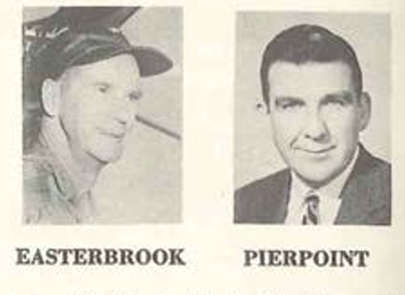
Photos of Easterbrook and Pierpoint, top right, page 14, Army Aviation, Vol. 8, No. 1, January 28, 1960.
Source: Pages 13 and 14, Army Aviation, Vol. 8, No. 1, January 28, 1960.
* * * * *
“Have a Seat,” the Man Said
Chief Warrant Officer Marvin V. Wingrove, assigned to the U.S. Army Transportation Material Command, St. Louis, recently returned to St. Louis from his 23,600 mile ferry flight as co-pilot for the famed Dr. Thomas Doolittle aircraft.
One incident he will always remember took place in one of the clubs in Lisbon, Portugal while waiting for favorable weather conditions. Wingrove stood by and watched a chess game being played by two members of the club.
Wingrove, an avid chess player, accepted an invitation to play the winner. He won all three games and after each win the spectators applauded his success. He was about to call it quits after hours of playing when a man stepped up from the audience and indicated he would he would like to “take on” Wingrove. The game resulted in Wingrove’s first defeat of the evening.
Later, Wingrove found out to his surprise that the first player was the chess champ of the club and his second challenger was Joaquin Duran, Portuguese National Chess Champion.
Source: Page 59, Army Aviation, Vol. 8, No. 2, February 28, 1960.
* * * * *
Bell’s Answer: “Go By Air”
Bell Helicopter’s air scooter has turned out to be one of the most widely publicized ground effect machines yet devised.
Capturing the fancy of editors throughout the nation, the 12 hp, 2-cycle motor scooter has been pictured in countless newspapers and magazines during January.
Let’s go a bit beyond the normal three-line caption and cover the mechanical details as presented by Bell. The air scooter, as verified by the rider, Colonel Robert R. Williams, of O.C.R.D., is a “weight shifter,” a vehicle that can be turned by the rider by shifting his weight, or moved forward or backward by leaning in those directions.
Built of fiberglass and aluminum, the 160 pound air scooter used a gasoline and oil mixture for fuel to turn 30-inch diameter fans, the resulting air blast lifting the vehicle about two-and-a-half inches off the ground.
No competition for George Romney, the vehicle only does 20 miles-per-gallon. However, it can travel up to 25 mph over roads, ice, snow and water, the last named “road” guaranteed to silence the normally vociferous Rambler owners.
Whether in the garage of under a camouflage net, the Bell air scooter is no space hog, measuring 30 inches high, 55 inches wide and 85 inches long.
As late as February 6th, the rider reported that the photo did not make any of the Washington, D.C newspapers for which he (pictured hatless) is thankful.
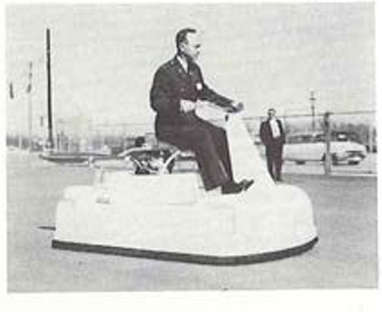
Photo, bottom left, page 70, Army Aviation, February 28, 1960 issue.
Source: Page 70, Army Aviation, Vol. 8, No. 2, February 28, 1960.
* * * * *
Test and Equipment: “Deadly!”
By Major Dorothy L. Johnson
A deadly “spider” spinning out a strand of wire web, will soon be services tested by the U.S. Army Aviation Board, Fort Rucker, Alabama.
The “spider,” in reality one of rocketry’s most effective developments, is the French-made SS-11 anti-tank guided missile system. The testing planned by the Board will evaluate the SS-11 as carried by and launched from the HU-1 Iroquois helicopter. The Infantry Board plans similar service tests—using the Jeep and ground launchers as vehicles—and the Armored Board will do their own testing from tanks and armored personnel carriers.
Simply put the principle involved is a missile, powered by solid propellant, which after being fired still remains under guided, manual control. A flare in the tail aids in visual tracking.
The missiles are directed to their targets by means of the trailing wires—which electrically transmit the gunner’s commands. A target that is trying to evade, or hide, can therefore be pursued. The SS-11 is capable of defeating any armored vehicles known today, and can destroy tanks while remaining out of effective range of the tanks’ own weapons.
An extraordinarily high degree of accuracy is another reason for the Army’s great interest in the SS-11.
The SS-11 is a further development of the SS-10 missile, both produced by the Chatillon factory of Nord Aviation. The SS-10 saw action against Egyptian armor during the Suez campaign. Used by Israeli forces, the SS-10 has been purchased by many additional free world nations, including the United States.
Weighing sixty-three pounds and measuring forty-six inches long, the SS-11 missile has been standardized for use on Sud Aviation’s Alouette helicopters as well as on the French Air Force’s Dassault Flament and the French Navy’s Vought AU-1 Corsair.
The three major components of the SS-11 consist of the motor section, which contains two solid-propellant sustainer rockets and the jet deviation control system; and mid-body section, which includes the trailing wire device, the power-driven gyro, the simple control system, and the short fins. The last component is the warhead.
The controlling of the missile after launching is easily accomplished by the gunner, and the entire design has been kept as simple as possible by Nord Aviation. It has been built with a view to possible rough handling during use in a combat area. The production costs are relatively low, being about $1,000 per round. The missile has a range of slightly over two miles, and the controlling wires disconnect upon impact.
The project officer selected for the SS-11 service test of the helicopter-mounted system is Captain Tony Carroll, of the U.S. Army Aviation Board.
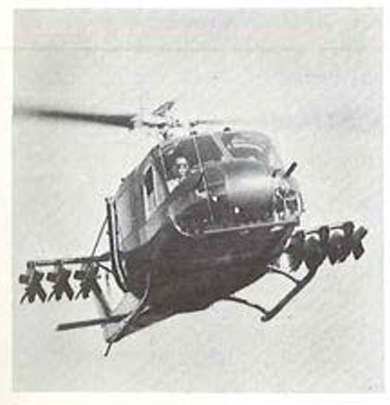
Photo, lower left, page 75, Army Aviation, February 28, 1960 issue.
Source: Page 75, Army Aviation, Vol. 8, No. 2, February 28, 1960.
* * * * *
Heavy Lift
Demonstrating its ability to carry more than 3,000 pounds of parts to another ship hypothetically damaged by enemy fire, an Army HU-1A Iroquois airlifts a tail boom assembly, two main rotor blades, and a pair of mechanics and tools as its cabin load, and a 1,245 pound sling load consisting of a replacement turbine engine and container.
Photo, top right, page 86, Army Aviation, February 28, 1960 issue.
Source: Page 86, Army Aviation, Vol. 8, No. 2, February 28, 1960.