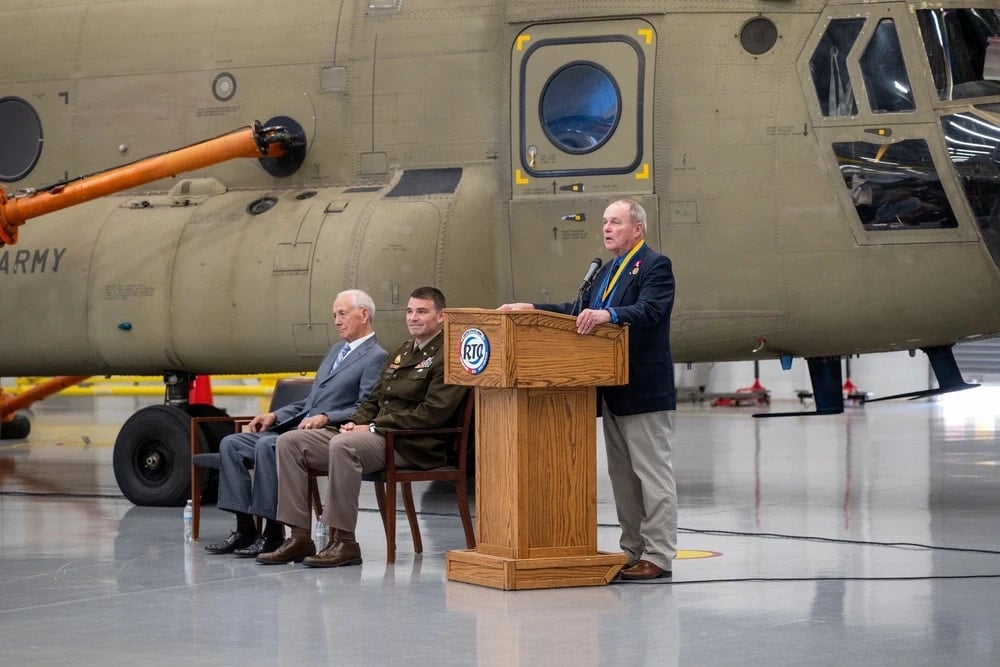
 Marvin "Lynn" Hanks delivers remarks during his retirement ceremony at the U.S. Army Redstone Test Center’s Aviation Flight Test Directorate on Redstone Arsenal, Alabama, on Oct. 22, 2026. Seated behind Hanks are retired Col. Austin Omlie, who presided over the ceremony, and current AFTD Commander Lt. Col. Dan Brown. In a fitting tribute to Hanks’ decades of pioneering cold-weather flight research, the ceremony was held in front of the Army’s CH-47 Chinook Helicopter Icing Spray System (HISS) test aircraft. Photo by Noah Ward.
Story by Christy Barnett
REDSTONE ARSENAL, Ala. (October 22, 2026) — For more than five decades, the story of United States Army aviation has been written in the skies, defined by rapid technological leaps, rigorous safety standards, and brave pioneers who pushed aircraft to their absolute aerodynamic limits. Few individuals have shaped this narrative as profoundly, or for as long, as Marvin “Lynn” Hanks.
This year, Hanks concludes an extraordinary career spanning 56 years of continuous service to the nation. From his collegiate beginnings in aerospace engineering and commissioning as a Corps of Engineers officer, to his final days of civil service at Redstone Arsenal, Hanks’ journey stands as a masterclass in flight test engineering, experimental Army aviation, and unwavering dedication to the Warfighter.
Early Roots and Vietnam Service
Born in 1947 in Memphis, Tennessee, Hanks developed an early fascination with flight and military service. While attending Frayser High School in Memphis, where he served as senior class president, his leadership in Junior ROTC earned him a four-year Army ROTC scholarship to Auburn University. At Auburn, Hanks immersed himself in the science of aeronautics, earning a bachelor’s degree in aerospace engineering in December 1969 while receiving his commission as a second lieutenant in the U.S. Army Corps of Engineers.
Entering active duty in January 1970, Hanks reported to Army fixed-wing flight training that fall, pinning on his aviator wings in January 1971. Following an initial assignment piloting the U-8 Seminole with the 5th Army flight detachment at Randolph Air Force Base, Texas, he completed rotary-wing qualification at Fort Rucker, Alabama, mastering the OH-58A Kiowa and UH-1 Iroquois.
In November 1971, Hanks deployed to Vietnam for a year-long combat tour. Operating in demanding and hostile combat conditions, he demonstrated remarkable adaptability by flying a diverse operational fleet that included the AH-1G Cobra attack helicopter, the O-1 Bird Dog, the U-6 Beaver, and the U-21A Ute utility turboprop. The crucible of combat flying instilled in him the foundational principles of situational discipline, technical precision, and aircraft survivability under fire.
The Active-Duty Flight Test Era (1973–1993)
Upon returning from Southeast Asia, Hanks turned his engineering intellect toward the demanding discipline of research, development, test, and evaluation. In January 1973, he arrived at Edwards Air Force Base, California, serving three years as a flight test engineer. During this tour, he played a central role in pioneering artificial icing flight tests utilizing the newly qualified Helicopter Icing Spray System, known across the Army test community as HISS.
In 1976, Hanks took his technical expertise overseas for two years with the Army Corps of Engineers flight detachment in Saudi Arabia, piloting the C-12A Huron and Convair 580 in support of vital regional infrastructure and advisory missions. His selection for the prestigious U.S. Naval Test Pilot School followed, graduating with Class 75 in June 1979 after intensive test evaluations on platforms such as the OH-58, AH-1G, and CH-46 Sea Knight.
As a newly minted experimental test pilot, Hanks was assigned to the Army Aviation Engineering Flight Activity, formerly the Army Aviation Systems Test Activity, at Edwards AFB. Between 1979 and 1984, he piloted developmental tests on frontline aircraft including the UH-60 Black Hawk, AH-64 Apache, CH-47 Chinook, OV-1 Mohawk, and RC-12 Guardrail, while concurrently graduating from the Army Command and General Staff College at Fort Leavenworth, Kansas.
His later active-duty years balanced operational strategy with cutting-edge flight research. From 1984 to 1986, Hanks served at the Pentagon with the Defense Intelligence Agency as a rotary-wing systems intelligence analyst. He returned to the cockpit in 1987 as a key member of the joint V-22 Multi-Service Test Team, flying and evaluating prototype tiltrotor flight dynamics to help usher in a new paradigm of vertical lift technology.
Hanks closed out his military service in leadership positions at Edwards AFB, serving as Director of Flight Test for the Army Aviation Engineering Flight Activity before commanding the Airworthiness Qualification Test Directorate from April 1990 until his active-duty retirement as a Lieutenant Colonel in October 1993.
Civil Service and the Modern Test Mission (1993–Present)
Recognizing that Hanks’ institutional memory and flight test acumen were irreplaceable, the Department of the Army immediately hired him as a civil service experimental test pilot in October 1993.
As the Army’s developmental aviation infrastructure transformed, Hanks remained at the center of the mission. When his directorate transitioned to the Aviation Technical Test Center at Fort Rucker, Alabama, in 1996, and subsequently consolidated under the U.S. Army Redstone Test Center at Redstone Arsenal in 2009, Hanks guided the enterprise through every evolution. Over his 33 years in civil service, he served in cornerstone roles as Chief Test Pilot, Fixed-Wing Standardization Pilot and Instructor Pilot, and the Army’s preeminent Subject Matter Expert and Test Director for aircraft in-flight icing protection systems.
Mastery of the Skies: 12,000 Accident-Free Hours
The breadth of Lynn Hanks’ flight resume is virtually unmatched in modern military aviation. As a dual-rated Master Army Aviator, he earned flight qualifications in 18 distinct military aircraft families, spanning six rotary-wing and 12 fixed-wing platforms that comprised more than 40 unique sub-variants. Whether evaluating attack helicopters like the Cobra and Apache, heavy-lift workhorses like the Chinook, utility lifelines like the Black Hawk and Huey, or fixed-wing platforms like the Mohawk, Beaver, Sherpa, and Huron, Hanks proved an adept and intuitive pilot in every cockpit.
Yet his most extraordinary accomplishment is the safety record that accompanied his experimental test envelope. More than 56 years spent piloting prototypes, developmental airframes, and heavily modified test articles through deliberate high-risk flutter, stalls, icing clouds, and structural strain, Hanks logged more than 12,000 accident-free flight hours. In a career lived on the absolute margins of aviation safety, his immaculate logbook remains a testament to rigorous preparation, methodical discipline, and uncompromising airmanship.
Mentorship and Global Aerospace Leadership
Beyond his own achievements at the flight controls, Hanks dedicated decades to cultivating the next generation of test professionals. As a standardization pilot and senior flight instructor, he personally trained generations of military and civilian experimental test pilots and flight test engineers in both fixed- and rotary-wing flight test techniques, instilling an enduring ethos of intellectual honesty and engineering rigor.
Hanks’ influence resonated throughout the international aerospace community. A fellow of the Society of Experimental Test Pilots (SETP), he was elected international president of the society for the 2000–2001 term and was honored in 2008 with the prestigious SETP James H. Doolittle Award for excellence in aerospace management and engineering. Demonstrating a lifelong commitment to educational advancement, he has also served as a trustee on the SETP Scholarship Foundation since 2005. He remains a life member of both SETP and the Society of Flight Test Engineers.
Honoring a Legend: The Retirement Ceremony
On Thursday, October 22, 2026, the aviation community gathered at the U.S. Army Redstone Test Center’s Aviation Flight Test Directorate on Redstone Arsenal to formally honor Hanks’ career. Presided over by retired COL Austin Omlie, the ceremony drew generations of colleagues, family members, and distinguished former Army leaders who had commanded the various test and developmental organizations where Hanks served across the decades.
During the ceremony, current AFTD Commander LTC Dan Brown delivered remarks capturing Hanks’ profound imprint on the organization and the wider Army enterprise.
“Lynn Hanks and flight test are interchangeable—they are one and the same,” Brown said. “When you think of Lynn Hanks, you think of flight test, and when you think of Army flight test, you think of Lynn Hanks. Lynn, this is a bittersweet moment for retirement. You have blazed many trails, carried out many missions, and taught all of us more than you will ever know. Thank you for letting us share in your 56 years of federal service.”
Addressing the colleagues, friends, and multi-generational family members gathered to celebrate his milestone, Hanks offered reflections marked by characteristic modesty and deep gratitude. Looking out across the flight test community, he underscored the professional bonds forged through decades of shared risk and discovery in the cockpit.
“As I look around the group here, I’ve probably flown with just about every pilot in this audience—and loved it. I loved every minute of it,” Hanks remarked. “Many flight test engineers out there I also had a chance to fly with and share technical ideas.”
He reserved special praise for the workforce at the Aviation Flight Test Directorate, acknowledging the exceptional caliber of the men and women who continue the mission.
“Everybody who’s ever served in AFTD understands the technical expertise, the high level of education, of understanding about the technical issues of flying, both fixed- and rotary-wing aircraft,” he noted, before drawing laughter by quipping that while he would have liked to fly with each new teammate, they were simply getting too young.
Turning to personal foundations, Hanks recognized his family in attendance and his wife of nearly 30 years, Kim, describing her as a cornerstone of his life and career. Noting that she is herself an accomplished flight test engineer at AFTD and recognized technical subject matter expert. Hanks credited her steadfast partnership, along with her artistic balance as a violist performing with the Madison City Community Orchestra, for keeping their shared journey grounded and fulfilling.
An Unrivaled 56-Year Journey
When Lynn Hanks first pulled pitch and advanced the throttles as a young Army aviator in 1970, military flight relied on grease pencils, paper aeronautical charts, and analog steam gauges. As he prepares to step away from his desk at AFTD, he leaves behind an Army aviation enterprise defined by digital glass cockpits, advanced fly-by-wire flight control architectures, integrated sensors, and air-launched effects—technologies he personally helped evaluate, refine, and prove airworthy.
During his unparalleled career, Lynn Hanks directly shaped the safety and capability of almost every aircraft in the modern Army inventory. From pioneering helicopter icing flight limits to directing critical aviation testing initiative, his work has been indispensable to the modernization of military aviation. Mr. Hanks’s technical expertise, visionary guidance, and enduring leadership have driven monumental advancements in flight test engineering, directly enhancing the survivability of combat effectiveness of countless Warfighters.
Thank you, Lynn, for 56 extraordinary years of keeping our aviators safe and our aircraft flying high.
*The U.S. Army Redstone Test Center is located at Redstone Arsenal, Alabama, and is a subordinate command of the U.S. Army Test and Evaluation Command. RTC provides technical expertise, state-of-the-art facilities, and capabilities to plan, conduct, analyze, and report the results of tests on missile and aviation systems, sensors, subsystems, and components. For more information, visit the U.S. Army Redstone Test Center. For more information, visit the U.S. Army Redstone Test Center website*.